Monthly vs yearly plans: how annual pricing changes revenue
Annual plans bring cash upfront and lower churn, but a discount trims revenue per customer. Here is the math, the benchmarks and when yearly billing pays off.
StartupsIntel team · Jun 11, 2026 · 7 min read
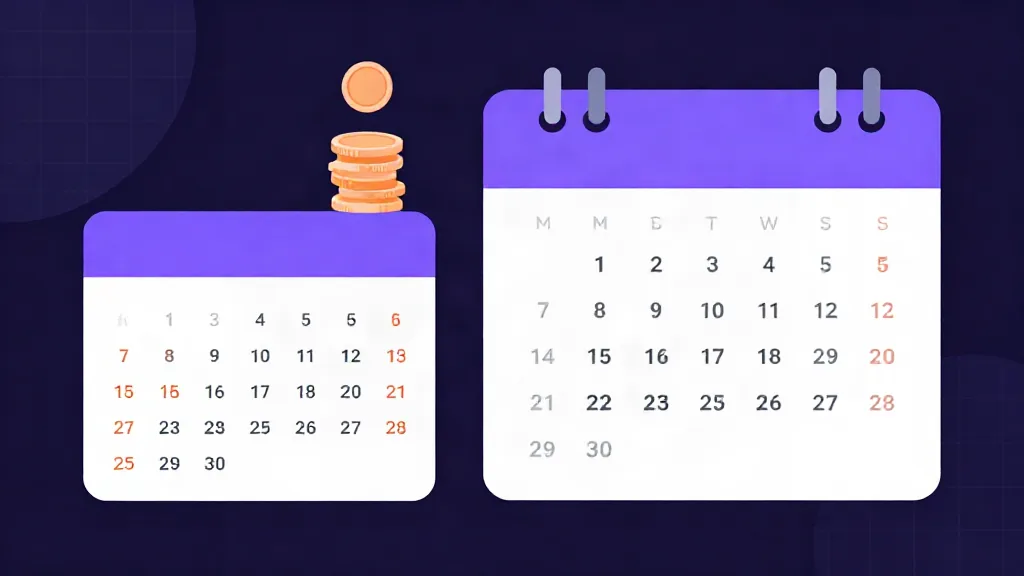
Yearly plans usually improve cash flow and reduce churn, but the discount lowers the revenue you collect per customer each month. Whether annual billing raises total revenue depends on how much customers would have stayed anyway and how large the discount is.
This guide walks through the math, the research, and the situations where each plan type wins.
The core trade-off
A yearly plan swaps a smaller price for a longer commitment. A common offer is two months free, which is about a 17 percent discount. Guides on the topic usually place typical discounts between 10 and 25 percent.
For the company, the trade looks like this:
| Factor | Monthly plan | Yearly plan |
|---|---|---|
| Price per month | Full | Discounted |
| Cash at signup | One month | Twelve months |
| Cancel opportunities per year | Up to 12 | One |
| Failed payment exposure | Every month | Once a year |
| Ease of selling | Easy | Harder, needs commitment |
The yearly plan gives up some price and gains cash and stability.
Why annual customers churn less
ChartMogul's explanation of billing cycles is worth reading. It points out that monthly billing gives customers up to 12 chances a year to cancel, while one upfront annual charge gives a single decision point. In its framing, annual plans show lower churn because customers face the decision less often, not because they are more loyal.
Billing also affects involuntary churn. Monthly billing has more charge attempts, so more chances for a card to fail. ChartMogul notes that an annual contract paid in installments brings back part of this risk, because each installment is a new attempt.
So the retention benefit is real, but it is partly mechanical. A customer who dislikes your product on day 60 can still leave on day 365, which only delays churn.
What the numbers look like
Published churn comparisons vary a lot, and most come from vendor content with different definitions. For example, Baremetrics, in its piece on annual versus monthly pricing, gives monthly churn of roughly 8.5 to 12 percent for monthly billing against about 3.1 to 7 percent per year for annual billing. Other sources give different units and sizes. One widely repeated claim, that companies with over 40 percent of customers on annual plans see around 30 percent lower churn, traces to ProfitWell research, and I could not verify it at the source.
The takeaway is directional. Annual billing lowers churn, the gap is large in most reports, and the exact figure depends on your market. Measure your own cohorts.
A worked example
Suppose a product charges $20 a month, or $192 a year, which is $16 a month and a 20 percent discount. Take 100 new customers on each plan, and assume the monthly cohort loses 8 percent of customers each month while the annual cohort loses none until renewal.
Monthly cohort, first year: customer counts fall month by month. Averaged over the year, you collect roughly 100 x 7.9 payments of $20, which is about $15,800. (The 7.9 is the sum of 0.92 raised to each power from 0 to 11, the share of customers still paying in each month.)
Annual cohort, first year: 100 x $192 = $19,200, all collected upfront.
In this example, the yearly plan collects about 21 percent more in year one despite the 20 percent discount, and it collects it on day one. If monthly churn were only 3 percent, the monthly cohort would average about 10.2 payments per customer and collect about $20,400, which beats the annual cohort. The result flips.
That is the lesson. Annual wins when monthly churn is high, and monthly can win when retention is already strong. Run the same arithmetic with your own churn.
Cash flow is a separate benefit
Even when total revenue is similar, annual plans pay you sooner. That cash can fund development, cloud costs or marketing without outside funding.
For AI products, there is an extra caution. If you collect a year of revenue upfront but pay for inference every month, a heavy user can cost more than they paid. Pricing yearly plans with usage caps or credit allowances avoids that. See unit economics for AI products.
How annual plans affect revenue estimates
Mix matters when you model a company from the outside. StartupsIntel's estimate assumes 80 percent of paying customers are on monthly billing and 20 percent on yearly. Yearly customers pay a lower monthly equivalent, so a higher yearly share slightly lowers monthly recurring revenue per customer, though it improves retention.
For example, with a $20 monthly price and a $16 monthly-equivalent yearly price, an 80/20 mix gives an average of $19.20 per paying customer per month. A 50/50 mix gives $18. The methodology page lists all assumptions, and any figure from the traffic checker is labelled as an estimate.
Choosing a discount size
There is no universal best discount. Consider these points.
- Start with two months free. It is easy to explain and sits within the common range.
- Match the discount to your churn. If monthly churn is high, a larger discount may pay off. If churn is low, a smaller discount protects revenue.
- Show dollar savings. Guides widely suggest displaying savings in money, such as "save $48," and not only as a percentage.
- Test the default toggle. Evidence on whether to default to annual is mixed, so test it.
- Avoid deep discounts early. A 40 percent discount trains customers to wait for deals.
When each plan fits best
When to push annual plans
Annual billing tends to fit best when:
- The product solves a recurring, stable need such as SEO, accounting or design.
- Customers are businesses that budget yearly.
- Your churn is high in the first months.
- You need cash to grow.
When monthly may be better
- Use is seasonal or project-based, like a single launch campaign.
- The product is new and unproven. Asking for a year of payment too early lowers conversion.
- Inference costs are high and unpredictable.
- Your audience is price sensitive and may avoid large upfront payments.
Offer both and learn
Most successful subscription products offer both options and let the data speak. Track revenue per visitor, early churn, refund rates and the share choosing annual. Sales also become easier when you let customers move from monthly to annual after they see value, with a small incentive at month three.
Handling renewals and refunds
Annual plans move the hard moment from every month to a single renewal date, so that date deserves care. Send a reminder two to four weeks before charging, state the amount, and make cancellation easy. Surprise renewals produce chargebacks and angry reviews, which cost more than the revenue they save.
Decide your refund policy before you sell yearly plans. A short window, such as 14 or 30 days, protects trust and rarely costs much. Also decide how to treat mid-year upgrades. Most products credit the unused portion of the old plan toward the new one, which feels fair and keeps upgrades smooth.
Finally, track the renewal rate of annual customers separately from monthly retention. It is the clearest sign of whether people truly value the product after a full year of use.
FAQ
How much should a yearly plan discount be?
Most guides place the range at 10 to 25 percent, and two months free, about 17 percent, is the most common choice. Pick a size based on your churn, since higher churn justifies a bigger discount.
Do annual plans always increase revenue?
No. They improve cash flow and retention, but the discount lowers revenue per month. If your monthly churn is already low, the monthly plan can generate more total revenue over time.
Should small AI startups offer yearly plans?
Usually yes, once the product has proven value, but with sensible usage caps. Upfront cash is valuable, and the cost of heavy usage must stay within what the customer paid.
Do annual plans reduce refunds?
Not necessarily. A large upfront charge can raise refund requests, so offer a clear refund window and good onboarding to protect trust.
annual billingsaas pricingchurncash flow